
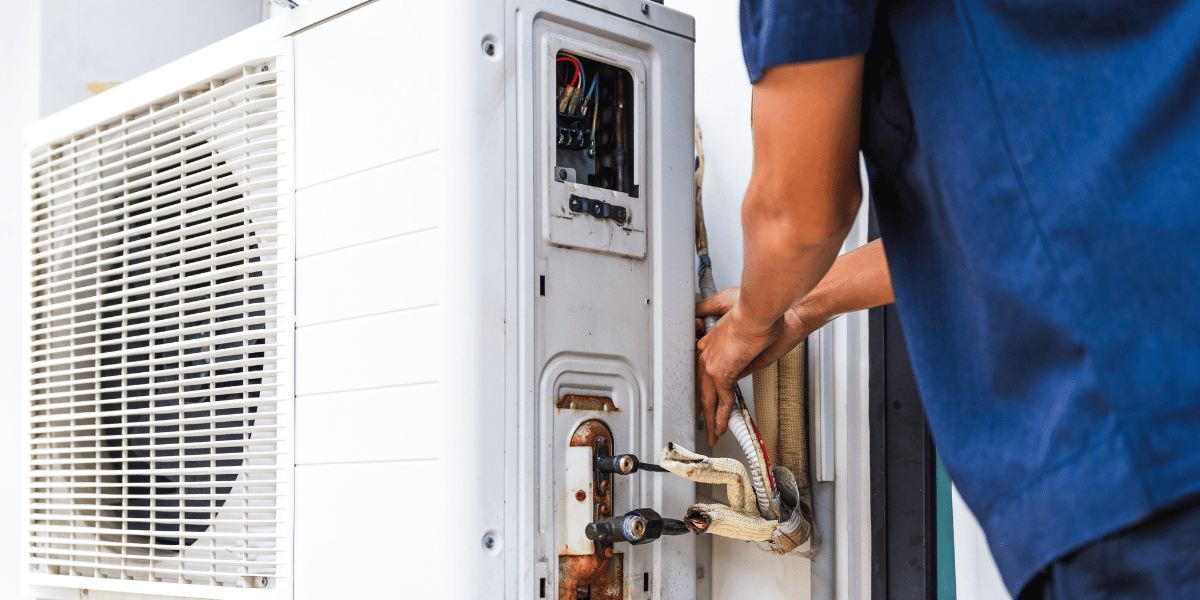
Why Mountain View Homeowners Are Switching to Ductless HVAC
Something is changing in Mountain View neighborhoods. Homeowners who have lived with the same central HVAC setup for decades are making a different choice when it comes time to replace aging equipment. Instead of simply swapping one ducted system for another, they are asking a more fundamental question: does my home actually need ductwork at all?
For a growing number of Bay Area residents, the answer is no. Ductless mini split systems have moved from a niche product to a mainstream solution, and the reasons are not hard to understand. These systems offer independent temperature control, high efficiency, quiet operation, and a level of installation flexibility that traditional central HVAC simply cannot match. In a city like Mountain View—where homes range from mid-century ranch houses with cramped attic spaces to modern townhomes and multi-unit properties—that flexibility is not just convenient. It is often the deciding factor.
At FairPrice Heating & Cooling, we have seen this shift firsthand. Homeowners across the Bay Area are reaching out not just for repairs or tune-ups, but for complete system transitions—removing old equipment and replacing it with ductless technology that fits their home and their lifestyle. One of our customers, Jeremy W. from San Francisco, put it simply after his mini split service: “These guys communicated well about arrival time, type of issue and possible fixes. The techs were professional and it would be easy to say we would hire them again.” That kind of experience is what the transition to ductless should feel like—clear, professional, and built around the homeowner’s needs.
The problem with older ducted systems in Mountain View homes
To understand why so many homeowners are making the switch, it helps to understand what they are switching away from. Many Mountain View properties were built in the 1950s through the 1980s, during an era when central forced-air systems were the standard. These homes were designed around a single furnace, a network of sheet metal ducts running through attic or crawl spaces, and a thermostat that controlled the entire house as one zone.
That design made sense at the time. But decades later, those same duct systems are often leaking, poorly insulated, and struggling to deliver conditioned air efficiently. The U.S. Department of Energy estimates that duct leakage alone can account for 20 to 30 percent of total heating and cooling energy loss in a typical home. In older Mountain View properties, that figure can be even higher.
Beyond efficiency, there is the issue of comfort. A single-zone system cannot account for the fact that a south-facing bedroom heats up faster than a north-facing living room, or that a converted garage needs conditioning while the rest of the house does not. Homeowners end up overcooling some rooms to keep others comfortable, or running the system longer than necessary to compensate for uneven distribution.
When the time comes to replace aging equipment, many homeowners realize that simply installing a new furnace and air conditioner into the same old duct system is not a real upgrade. It is just new equipment fighting the same old inefficiencies.
What makes ductless systems different
A ductless mini split system eliminates the duct network entirely. Instead of conditioning air in a central unit and pushing it through a building-wide distribution system, a mini split delivers conditioned air directly into the room where it is needed. Each indoor air handler operates independently, controlled by its own thermostat or remote. The outdoor compressor unit connects to the indoor handlers through a small conduit containing refrigerant lines, a power cable, and a condensate drain line—all routed through a hole typically no larger than three inches in diameter.
This architecture has several important implications. First, there is no energy lost to duct leakage because there are no ducts. Second, each zone can be set to a different temperature, meaning the home office can be cooled while the bedrooms remain at a comfortable sleeping temperature. Third, the system can be installed in spaces where ductwork would be impractical or prohibitively expensive to run.
The Environmental Protection Agency (EPA) recognizes ductless heat pump systems as among the most energy-efficient residential HVAC options available. Modern inverter-driven mini splits adjust their output continuously to match the actual load of the space, rather than cycling on and off at full capacity. This variable-speed operation is one of the primary reasons these systems consume significantly less energy than traditional equipment.
The Mountain View homes that benefit most from going ductless
While ductless systems can work well in almost any residential setting, certain Mountain View home types are particularly well-suited to the technology.
Older ranch-style homes with limited attic clearance are among the most common candidates. These properties often have ductwork that runs through unconditioned spaces, is difficult to access for repairs, and would require significant structural work to replace or extend. A ductless system bypasses all of that, delivering comfort without touching the existing infrastructure.
Homes with room additions or converted spaces are another natural fit. As we explored in our guide on ductless mini split solutions for home additions, extending central ductwork to a new room is often more expensive and disruptive than simply installing a dedicated mini split for that space. The same logic applies to garage conversions, sunrooms, and ADUs.
Multi-story homes where temperature stratification is a persistent problem also benefit greatly. Hot air rises, which means upper floors in Mountain View homes can be significantly warmer than lower levels during summer. A ductless system on each floor allows homeowners to address this imbalance directly, rather than fighting it with a single thermostat.
Finally, homeowners who are planning to reduce their reliance on natural gas will find that ductless heat pump systems align perfectly with that goal. Because these systems run entirely on electricity and do so with exceptional efficiency, they are a natural complement to solar panels and a key step toward a fully electrified home.
What the full transition process looks like
One of the most common questions homeowners ask is what it actually takes to switch from a traditional system to ductless. The answer depends on the specific home and the scope of the project, but the general process follows a clear sequence.
The first step is a professional assessment. Our technicians evaluate the home’s layout, insulation levels, window area, and existing HVAC infrastructure to determine the right number of zones and the appropriate capacity for each indoor unit. This load calculation is essential—an undersized system will struggle to maintain comfort, while an oversized system will short-cycle and create humidity problems.
Once the system is designed, the old equipment is removed. This includes the existing furnace or air handler, the outdoor condenser unit, and in many cases the ductwork itself if it is no longer needed. Our team handles the full removal process, ensuring that the space is clean and ready for the new installation.
The outdoor compressor unit is then positioned and secured, typically on a concrete pad or wall-mounted bracket. Indoor air handlers are installed in each zone—mounted high on the wall for optimal air distribution. The connecting conduit is routed through the wall and concealed as cleanly as possible. Electrical connections are made, refrigerant lines are pressure-tested and charged, and the system is commissioned and tested through a full operating cycle.
| Transition Step | What It Involves | Typical Timeline |
|---|---|---|
| Professional assessment | Load calculation, zone planning, equipment selection | 1–2 hours |
| Old system removal | Furnace, condenser, and ductwork removal | Half to full day |
| Outdoor unit installation | Placement, mounting, electrical connection | 2–4 hours |
| Indoor unit installation | Wall mounting, conduit routing, refrigerant lines | 2–4 hours per zone |
| System commissioning | Pressure testing, refrigerant charge, full cycle test | 1–2 hours |
| Homeowner walkthrough | Controls, settings, maintenance guidance | 30–60 minutes |
The total timeline for a standard single-home transition is typically one to two days, depending on the number of zones and the complexity of the installation.
The role of honest guidance in making the right choice
Not every Mountain View home is an ideal candidate for a full ductless conversion, and we believe homeowners deserve to hear that honestly. Homes with newer, well-maintained ductwork and recently replaced central equipment may not benefit enough from a full transition to justify the cost. In those cases, a hybrid approach—keeping the central system for the main living areas while adding ductless units for specific zones—may be the more practical solution.
This kind of honest guidance is something our customers consistently mention. Ghaida N. from San Jose shared her experience: “I talked to the owner about what was wrong with my mini-split and he was very honest in his feedback about what I needed to do. He didn’t prioritize getting my business at any cost. He prioritized what’s best for me to do under the circumstances which I really appreciated. Not everyday you get to work with high integrity people.”
That philosophy shapes every consultation we conduct. Our goal is to help Mountain View homeowners make the decision that genuinely serves their home, their comfort, and their budget—not the decision that generates the largest invoice.
Efficiency, incentives, and long-term value
The financial case for ductless systems has strengthened considerably in recent years. Federal tax credits under the Inflation Reduction Act provide meaningful incentives for qualifying heat pump installations, and California utility programs offer additional rebates for high-efficiency electric HVAC equipment. The California Energy Commission actively promotes heat pump technology as part of the state’s clean energy strategy, and local utilities have programs designed to reduce the upfront cost of making the switch.
Over the life of the system, the energy savings from eliminating duct losses and operating at higher efficiency levels can be substantial. Homeowners who switch from older, inefficient central systems often see noticeable reductions in their monthly utility costs, particularly during the summer cooling season when the efficiency advantage of inverter-driven technology is most pronounced.
With proper annual maintenance—cleaning filters, checking refrigerant levels, and inspecting electrical components—a quality ductless system can deliver 15 to 20 years of reliable service. That longevity, combined with the elimination of duct maintenance costs, makes the long-term value proposition of going ductless genuinely compelling for many Mountain View homeowners.
Why Mountain View homeowners choose FairPrice Heating & Cooling
Since 2012, FairPrice Heating & Cooling has been a trusted HVAC partner for Bay Area homeowners. As a family-owned and operated company, we approach every project with the same commitment to honest pricing, technical excellence, and genuine customer care that has defined our business from the beginning.
Our technicians are licensed, insured, and experienced with the full range of ductless systems available today. We handle the complete transition process—from removing old equipment to commissioning the new system—so homeowners have a single, accountable partner throughout the project. We offer 24/7 emergency service, flexible financing options, and a 100% satisfaction guarantee on all of our work.
Paula Barnes, one of our customers, described her experience this way: “FairPrice Heating & Cooling was absolutely amazing from start to finish. The manager and his team were incredibly professional, careful, and thorough throughout the entire process. They took the time to explain everything in detail, showed us exactly what needed to be fixed, and made sure we fully understood our options—no pressure, no confusion. You can really tell they care about doing the job right and about their customers.”
That is the standard we hold ourselves to on every project, whether it is a single-zone installation or a complete whole-home ductless conversion.
Take the next step toward ductless comfort
If your Mountain View home has aging HVAC equipment, persistent comfort problems, or spaces that have never been properly conditioned, a ductless system may be exactly what you have been looking for. The technology is proven, the efficiency benefits are real, and the installation process is far less disruptive than most homeowners expect.
Contact FairPrice Heating & Cooling today to schedule a professional consultation. Our team will evaluate your home, explain your options honestly, and help you determine whether going ductless is the right move. Call (408) 608-8246 to get started.
FAQ
How disruptive is the process of switching from a ducted system to ductless?
The transition is significantly less disruptive than most homeowners expect. Because ductless systems require only a small conduit hole rather than extensive duct runs, the installation involves minimal cutting or structural work. Most full transitions are completed within one to two days, and our team cleans up thoroughly before leaving.
Can a ductless system heat and cool my entire Mountain View home?
Yes, a properly designed multi-zone ductless system can handle the full heating and cooling needs of most Mountain View homes. The key is accurate load calculation and correct zone planning, which our technicians perform before any equipment is selected. Homes with unusual layouts or very high ceilings may require additional zones to achieve consistent comfort.
What happens to my existing ductwork when I switch to ductless?
In most cases, the existing ductwork is removed as part of the transition. If the ducts are in good condition and serve a purpose—such as supporting a ventilation system—they may be retained. Our technicians will assess the existing infrastructure and make a recommendation based on the specific situation in your home.
Are ductless systems difficult to operate?
Not at all. Most ductless systems come with intuitive remote controls, and many modern units are compatible with smartphone apps and smart home platforms. During the installation walkthrough, our technicians explain all of the controls and settings so homeowners feel confident operating the system from day one.
How do ductless systems perform during Mountain View’s warmer summers?
Very well. Modern mini split systems are rated to handle outdoor temperatures well above what Mountain View typically experiences, and their variable-speed operation allows them to maintain consistent indoor temperatures even during extended heat events. Proper sizing is the most important factor in summer performance.
What maintenance does a ductless system require?
The primary homeowner maintenance task is cleaning the air filters in each indoor unit, which should be done every few weeks during periods of heavy use. Beyond that, we recommend an annual professional service visit to inspect refrigerant levels, clean the outdoor unit, and verify that all components are operating correctly.
Is financing available for a ductless system installation?
Yes. FairPrice Heating & Cooling offers flexible financing options to help Mountain View homeowners manage the upfront cost of a ductless transition. Combined with available federal tax credits and California utility rebates, financing can make the switch to ductless very accessible from a budget standpoint.